-
Your shopping cart is empty!

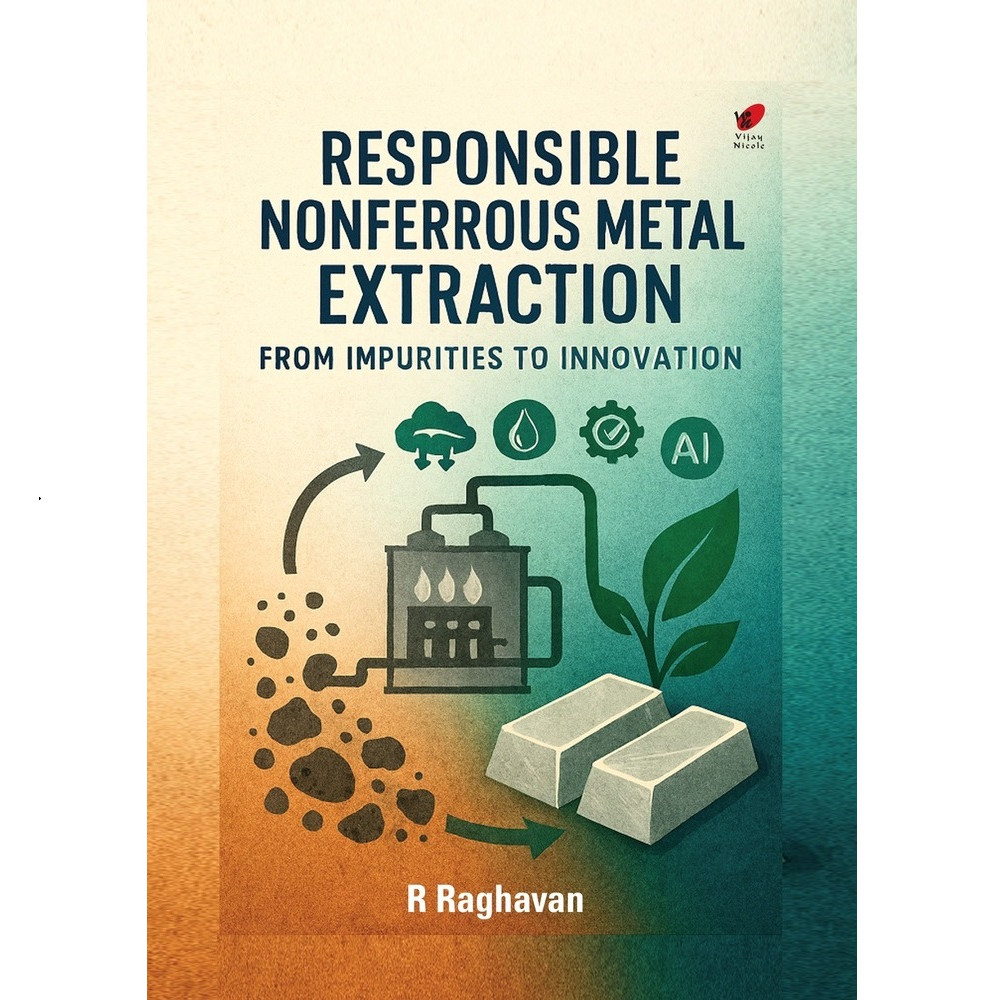
This book responds to the urgent call for responsibility, transparency, and innovation in nonferrous metallurgy.
Building upon Environmental Issues and Challenges in Nonferrous Metals Production in India, it expands into
ESG integration, green innovation, and regulatory transformation—placing metallurgy at the intersection of
science, sustainability, and accountability.
CONTENTS
About the Author
Preface
Acknowledgement
Chapter 1 Introduction: Foundations of Responsible Nonferrous Metallurgy –
Historical Overview, Global Urgency, Rationale for ESG Integration
Chapter 2 Impurities in Feed Materials: Classification, Challenges, and Opportunities –
Typology, Detection Methodologies, Circuit Impact, AI-Based Impurity Profiling
Chapter 3 Environmental Challenges in Nonferrous Metal Extraction –
Air Pollutants, Water Contamination, Solid Waste Handling, Effluent Toxicity
Chapter 4 The Emergence of ESG Compliance in Nonferrous Extractive Metallurgy –
Governance Indicators, Stakeholder Engagement, and Risk Protocols
Chapter 5 Mercury and Heavy Metal Toxicity –
Emissions, Waste Treatment, Health, Environmental Consequences, and Regulatory Frameworks
Chapter 6 Advances in Industrial Waste Treatment Technologies –
Emerging Techniques for Slag, Sludge, and Effluent Detoxification
Chapter 7 Case-Integrated Innovative Waste Treatment Technologies in Nonferrous Metallurgy –
Arsenic Sludge Stabilization, Copper Slag Reuse, Ba(OH)2-Driven TDS Reduction, SO2 Scrubbing Excellence
Chapter 8 Innovative Metallurgical Practices for Sustainability –
Process Reconfiguration, Hybrid Flowsheets, Lifecycle Optimization
Chapter 9 Impurity Impact on Process Efficiency and Environmental Performance –
Circuit Disruptions, Resource Losses, Mitigation Approaches
Chapter 10 Regulatory Frameworks and Compliance Protocols –
Indian Laws, Global Benchmarks, Enforcement Gaps, Harmonization Strategy
Chapter 11 Future Outlook in Green Metallurgy –
Clean Tech Trends, Circular Economy, Pilot Roadmap, Digital Governance
Chapter 12 ESG Case Studies in Nonferrous Metallurgy –
Four Detailed Narratives, Real-World Implementations and Results
Annexure A: Glossary of Terms and Concepts
A1: Metallurgical Terminology
A2: Environmental Safeguards and Control Techniques
A3: ESG in Nonferrous Metallurgy
Annexure B: Case Study Compendium – ESG Driven Practices in Indian Metallurgy
B1: Strategic Management of Copper Converter Slag in Nonferrous Smelting
B2: Environmental Management Strategies at an Integrated Zinc Smelting Complex
B3: Environmental Management at an Aluminium Smelter Complex
B4: Air Emissions Governance at Indian Copper, Lead and Zinc Smelters
B5: Comparative Environmental Management Strategies at Integrated Zinc and Aluminium Smelting Complexes
B6: Environmental Management Strategies at an Integrated Zinc Smelting Complex
B7: Environmental Management at Aluminium Smelter Complex
B8: Air Emissions Governance at Indian Copper, Lead and Zinc Smelters
Annexure C: Impurity Management & Waste Treatment
C1: Process-Specific Impurity Removal Techniques
C2: Comparative Matrix of Waste Treatment Technologies
Annexure D: Regulatory Benchmarks & Governance Protocols
D1: Indian Policies on Nonferrous Waste, Emissions, and ESG Enforcement
D2: Global Protocols – EU REACH, US EPA, METI (Japan)
D3: Harmonization Strategy and Gap Analysis
D4: Global Air Emission Governance in Nonferrous Smelters
Annexure E: ESG Audit Checklist – Indian Nonferrous Metallurgical Operations
E1: Clean Extraction Technologies – Green Reagents, Eco-design
E2: AI and Machine Learning in Metallurgy – Smart Profiling & Forecasting
E3: Lifecycle Sludge Valorization – Recovery Routes, Circuit Integration
Annexure F: Author’s Publications (Books and Papers) and Contributions to Chapters of this Book –
Responsible Nonferrous Metal Extraction – From Impurities to Innovation
Annexure G: Legacy Reference and Strategic Mapping –
Environmental Issues and Challenges in the Extraction of Nonferrous Metals Production in India
Conclusion
Index
R. Raghavan is a retired industry professional with decades of expertise in nonferrous extractive metallurgy. His distinguished career at Hindustan Zinc Limited encompassed strategic contributions across multiple operational units, shaping both practice and documentation in the field.
He has authored six widely respected books addressing environmental and metallurgical challenges, known for their scholarly depth and practical relevance. Currently, he leads the formalization of the India Zinc Research Centre, championing sustainable industrial research and regulatory excellence.
Renowned for his editorial precision, legacy-driven documentation, and commitment to institutional discoverability, Raghavan continues to mentor teams in technical writing, compliance, and process visualization. This latest work reflects his enduring dedication to advancing knowledge in nonferrous metal extraction and environmental stewardship.
Reviews
L. Pugazhanthy
Past President
The Indian Institute of Metals
39 Tughlaqabad Institutional Area,
M.B. Road, New Delhi – 110062
12 September 2026
“Responsible Non-Ferrous Metal Extraction – From Impurities to Innovation”
At the outset, I must compliment the author Dr. R. Raghavan for his unlimited passion to share his rich knowledge and wide experience by writing the above book, after his retirement, for the benefit of the professionals in the non-ferrous metals industry, teachers, researchers, students etc.
The title of the book is in itself very thoughtful as it deals with “Responsible Extraction, From Impurities to Innovation”; the book talks about the latest concept namely ESG Compliance.
Mercury and Heavy Metals Toxicity, Environmental Challenges, Advances in Waste Water Treatment, Green Metallurgy, Sustainability, Case Studies, Future Outlook etc. are all covered in detail through informative chapters.
The annexures deal with, among other aspects, AI and Machine Learning in Metallurgy as well as Regulatory Benchmarks.
No doubt this book deserves to be prescribed as an important Guidance Manual for the policy planners, regulatory officials, practicing professionals in the industry as well as academia.
May the author live long and continue with his literary contributions in the years to come.
L. Pugazhanthy
Executive Director
INDIA LEAD ZINC DEVELOPMENT ASSOCIATION
Past President
The Indian Institute of Metals
39 Tughlaqabad Institutional Area,
M.B. Road, New Delhi – 110062
12 September 2026
“Responsible Non-Ferrous Metal Extraction – From Impurities to Innovation”
At the outset, I must compliment the author Dr. R. Raghavan for his unlimited passion to share his rich knowledge and wide experience by writing the above book, after his retirement, for the benefit of the professionals in the non-ferrous metals industry, teachers, researchers, students etc.
The title of the book is in itself very thoughtful as it deals with “Responsible Extraction, From Impurities to Innovation”; the book talks about the latest concept namely ESG Compliance.
Mercury and Heavy Metals Toxicity, Environmental Challenges, Advances in Waste Water Treatment, Green Metallurgy, Sustainability, Case Studies, Future Outlook etc. are all covered in detail through informative chapters.
The annexures deal with, among other aspects, AI and Machine Learning in Metallurgy as well as Regulatory Benchmarks.
No doubt this book deserves to be prescribed as an important Guidance Manual for the policy planners, regulatory officials, practicing professionals in the industry as well as academia.
May the author live long and continue with his literary contributions in the years to come.
L. Pugazhanthy
Executive Director
INDIA LEAD ZINC DEVELOPMENT ASSOCIATION

Training & Development
₹550.00
FEATURESIdeal blend of theory and practice of training and development.Includes 18 case studies.22 m..

Product Management 3e
₹595.00
This book is designed as a core textbook for students specialising in marketing and as a reference f..

The AI-Powered Marketing Playbook - The Next Practices for Marketing Excellence
₹395.00
Crafted for students, professionals, entrepreneurs, and curious minds, this book simplifies complex ..

Legal Aspects of Business, 2e
₹695.00
This edition of Legal Aspects of Business is thoroughly revised with respect to Company Law provisio..

Industrial Relations, Labour Welfare and Labour Laws
₹695.00
The book covers topics on social security, wage and salary administration, worker participation in m..

Operations Research, 2e
₹995.00
This book combines clarity of concepts with academic rigours. It adopts a step-by-step approach to l..
Financial Services & Systems 2e
₹575.00
Financial Services and System imparts knowledge in the various areas of financial services and syste..

Fundamentals of Production & Operations Management
₹550.00
This comprehensive book on Fundamentals of Production and Operations Management has been designed to..

Marketing Management - Text and Cases, 2e
₹695.00
This contemporary and comprehensive textbook, now in its second edition, has its emphasis on emergin..
-250x250.png "A Student Handbook on Company Law and Practice, 3e")
A Student Handbook on Company Law and Practice, 3e
₹695.00
This book is designed as a textbook for professional courses and other allied business courses. It i..
Financial Management 4e
₹995.00
The comprehensive first course textbook provides in depth coverage of the principles and practise of..
Strategic Management
₹450.00
This book, Strategic Management introduces students to the core principles of strategic planning and..

Security Analysis & Portfolio Management
₹550.00
This text provides an in-depth introduction to the theoretical framework of Security Analysis and Po..


